Sources:
 |
| Apollo 11 Crew. |
Image: http://www.nasm.si.edu/collections/imagery/apollo/as11/images/AS11_crew.jpg
Neil Armstrong Reading The Plaque on the Apollo 11 Spacecraft
2. http://www.nasa.gov/mission_pages/apollo/missions/apollo11.html
 |
| Apollo 11 Mission Patch |
Image: http://www.nasa.gov/images/content/338751main_11-lg.jpg
3. http://www.historyplace.com/unitedstates/apollo11/
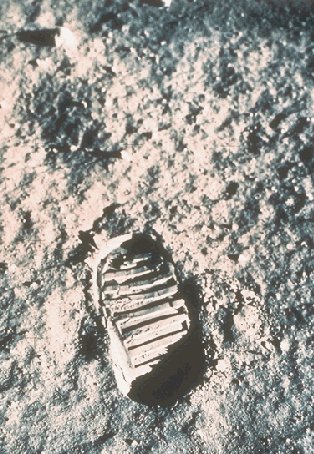 |
| Neil Armstrong said, "That's one small step for man, one giant leap for mankind." |
This website has an easy to understand, timeline set-up of the Apollo 11 mission and aftermath. It starts off stating about the crew and takeoff and ends with the parade for the Hero Astronauts. This article uses many images to explain the different parts of the mission.
Image: http://www.historyplace.com/unitedstates/apollo11/fprint.jpg
This website is an exceedingly large gallery of images from Apollo 11 mission ranging from the crewmen training to the aftermath. The is a great website for photographic primary sources.
 |
| Lunar Module Inspection After Undocking |
 |
| Buzz Aldrin Salutes the U.S. Flag |
 |
| Apollo 11 Astronauts, still in their quarantine van, are greeted by their wives upon arrival at Ellington Air Force Base |
Above Left http://history.nasa.gov/ap11ann/kippsphotos/6574.jpg
Above Right http://history.nasa.gov/ap11ann/kippsphotos/5875.jpg
Above Center http://history.nasa.gov/ap11ann/kippsphotos/40147.jpg
5. http://www.astronautix.com/flights/apollo11.htm
This website article has a different layout than the other sources that I have researched from. It starts out as summary of the mission and moves on to a timeline of the Apollo 11 Chronology. I learned that there were a proposed sequence of Apollo missions leading to the lunar landing mission:
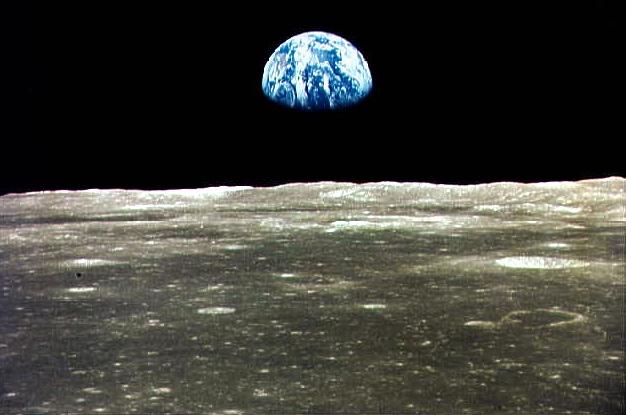 |
| View of Earth rising over Moon's horizon taken from Apollo 11 spacecraft |
Conclusion
From researching from these website articles, I have learned various facts about the Apollo 11 Mission, which launched on July 16, 1969. From the chronological timelines, I understand how the Apollo 11 mission came to be and why and how it happened. It had always been mankind's dream to step foot on the moon and because of the Preliminary Apollo Reliability Report, commissioned May 16-June 15, 1965, the Apollo 11 mission came to be. Apollo 11 has lead to many other discoveries about the moon and the universe and has been a larger motivation to continue to explore the rest of the universe. It can also be a reminder for those who are not sure if they can fulfill a dream. I say go for it. It may take time, but it will be well worth it in the end.
"Mystery creates wonder and
wonder is the basis of a man's desire
to understand."
Neil Armstrong, Astronaut of Apollo 11

Perfect collection of sources!! I have always been fascinated by space and all the mysteries that it still holds!
ReplyDelete